


The Fisherman: A Story Carved in Wood

One sculpture, two woods, and a story that continues around the back.
An invitation to look again
The first thing to know about Lawaiʻa | The Fisherman is that its maker does not want you to stop at the front. Avi Molinas describes the sculpture by moving around it: from the head and arms to the carved markings along the body, then to two figures on the back that a quick glance might miss. He also invites something less common in a gallery: touch. For Avi, the surface is not a barrier between a collector and the wood. It is part of the encounter.
A fisherman, and a family history
Avi's choice of subject is personal. His family comes from fishermen, and he connects the fisherman with the relationship between people, the ocean and ʻāina. In his account, fishermen bring food, health and happiness; they make the connection between land and human life tangible. The sculpture does not present a documentary portrait of one person. Its form brings together a human figure and the movement of life in the water.
Born in Barcelona, Avi has lived on Maui since 2006 and works in Maliko Gulch on the North Shore. His carving practice uses gifted Maui timber. Those facts matter here because the story is not simply about an ocean subject: it is also about the specific material he has worked with, and the place where he has built his practice.
Two woods, two characters
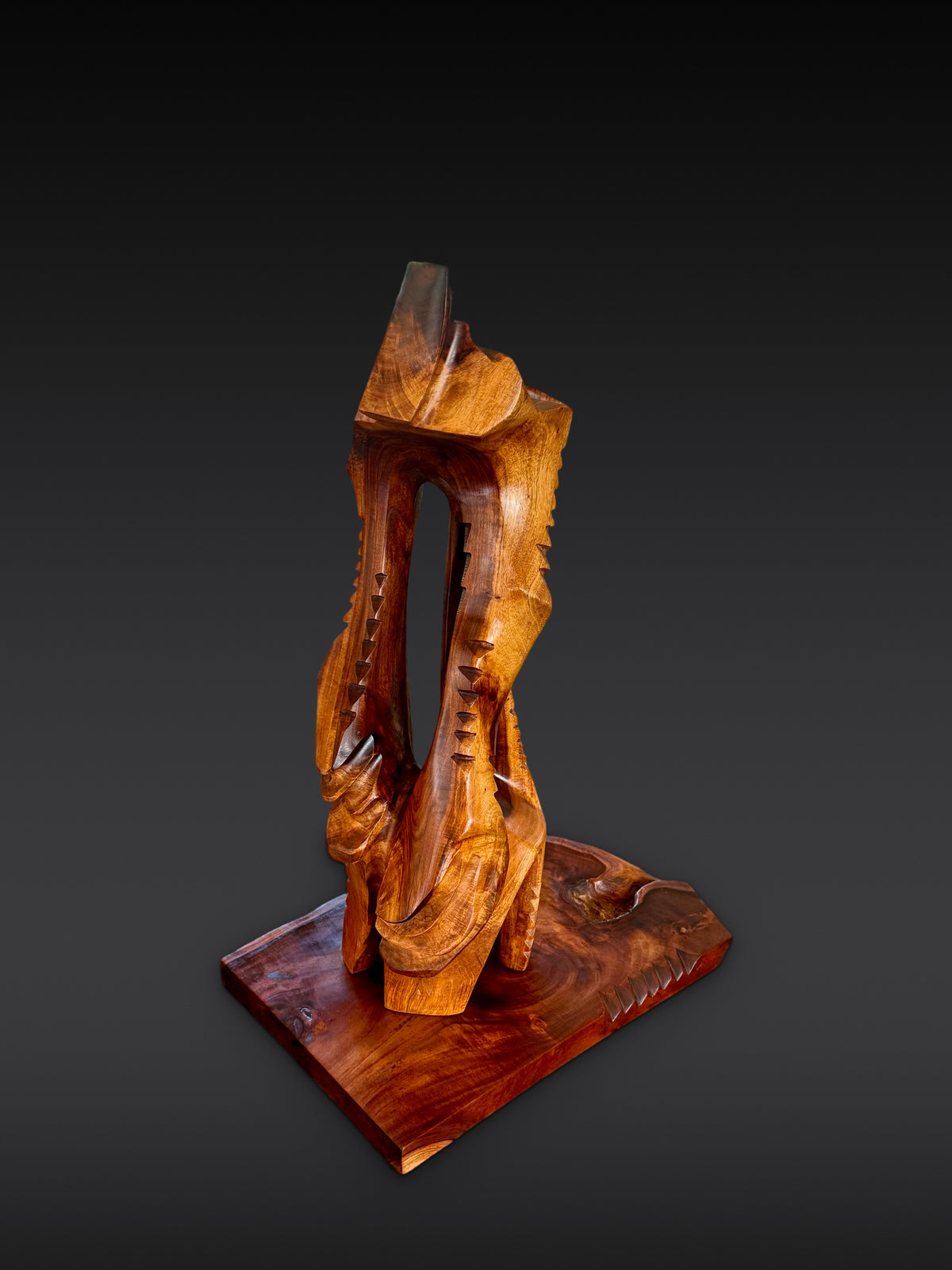
The figure is carved in kou and stands on a milo base. Avi speaks of kou's beautiful grain and its long use for everyday objects, including bowls and tools. He describes milo differently: darker and stronger, with freshly cut red color that changes as oil is applied. The distinction is visible in the finished work. The sculpture and its base do not disappear into one uniform brown surface; they retain different grain, tone and presence.
That difference is worth looking for before turning to the figure itself. A work carved from wood is shaped by decisions about material as well as subject. In Lawaiʻa, the base is not merely a neutral support. Avi has chosen another wood with a character of its own. The viewer can read the relationship between the two without needing to know the terminology first.

A figure between water and land
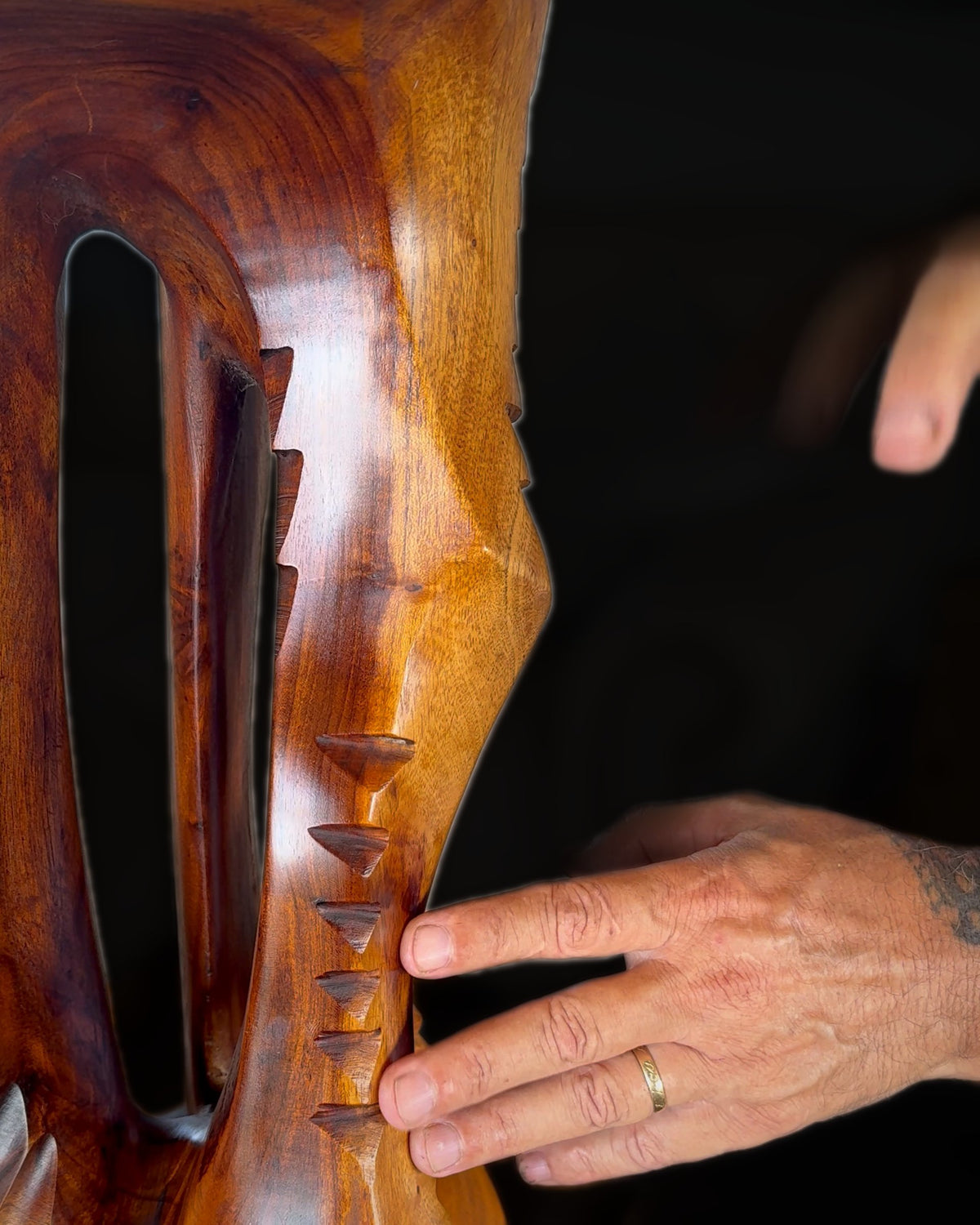
Avi describes the head at the top, followed by arms whose hands resemble paddles or fins. The fisherman is, in his words, half fish and half human. He can swim; he can paddle a canoe. The form moves between human anatomy and the means of traveling through water. Rather than spelling out one fixed interpretation, Avi points to what he has carved and lets the associations unfold.
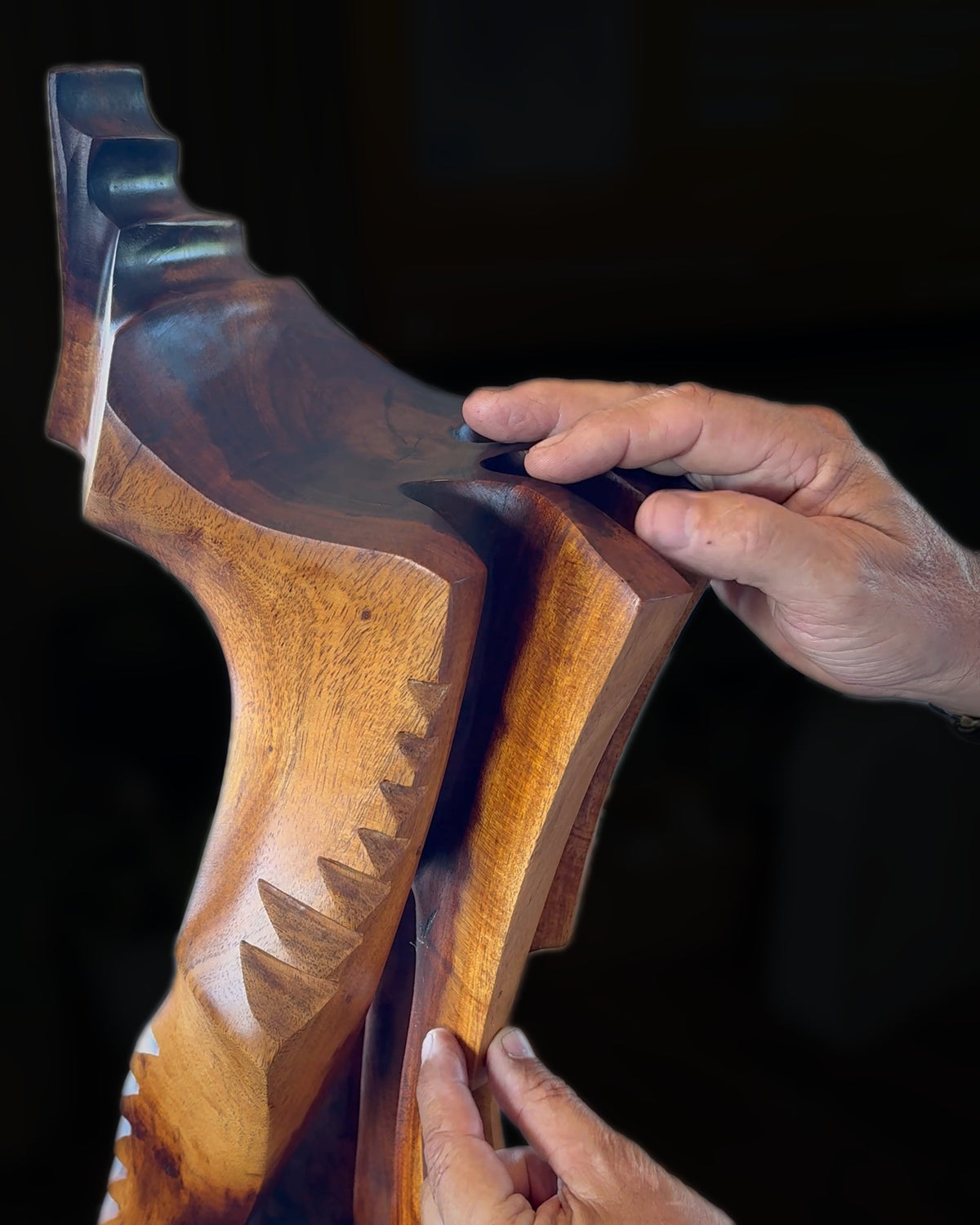
Along the body, triangular carvings carry another layer. Avi connects their shape with the mark of a shark's bite and speaks of good luck and protection for fishermen. This is his explanation of the markings on this work, not a claim that every triangle in Hawaiian art has the same meaning. The distinction matters: the most reliable guide to this particular sculpture is the artist himself.
The family on the other side
Turn the sculpture and the story changes. Avi identifies two smaller figures on the back as family members, perhaps a wife and a daughter or son. He describes them as protective presences. Their placement asks something of the viewer: to keep looking, and to recognize that the most important detail may not be visible from the position in which a sculpture is first displayed.
A closer look at the back
The figures Avi identifies on the reverse are easy to miss if the sculpture is photographed from only one angle. A front-and-back pairing gives the viewer the same invitation Avi offers in person: keep moving. His explanation belongs alongside the images, rather than in a detached caption that reduces the figures to decoration.
A sculpture occupies space differently from a painting or photograph. Its back is not automatically secondary. Here it holds part of the emotional structure of the work. The fisherman is a figure associated with the ocean, but he is not imagined alone. Family accompanies him.
The long work after carving
Avi estimates that the sculpture took three or four months, sometimes longer in the way he recounts the process. Carving the form was only the beginning. He describes a prolonged sequence of sanding and finishing, reaching very fine abrasives and applying many coats of oil—roughly sixteen to twenty in his account. Those repetitions are not easy to appreciate from a photograph. They become legible in the surface and in the way light moves across the wood.
He is explicit that the finish is oil rather than a hard sealed surface. He invites collectors to touch the sculpture and connect with the wood. Any handling should follow the artist's own care guidance, but the invitation tells us something fundamental about his intention: this object is meant to be experienced as material, not merely recognized as an image.
Listen to the fisherman
Near the end of his explanation, Avi compares the finished piece to a Stradivarius and hopes that people can hear the fisherman's music. It is an unexpected comparison, but an illuminating one. Months of shaping and finishing serve an encounter that cannot be reduced to measurements or materials. The wood holds a figure; the figure holds relationships; and the viewer is invited to discover them in time.
Lawaiʻa | The Fisherman is a unique original sculpture completed in 2021. It stands 28 inches high, with a kou figure and milo base. The artist's video walk-through accompanies the artwork through Maui Fine Art Collective. To understand the work more fully, begin with the sculpture, follow Avi's explanations, and—just as he asks—look all the way around.
Where to continue
The artwork page carries the artist’s original walk-through, dimensions and current collecting information. Avi’s artist page follows his broader practice in sculpture and painting. Read both if you want to understand how this single work fits into a lifetime of looking and making.
